What is strategy?

Last week I started a new job as a communication strategist.  So a recent Forbes article entitled Here’s Why People Don’t Get Your Strategy immediately grabbed my attention.

The article’s author, Russell Raath, argues convincingly that the word ‘strategy’ is one of ‘the most used and least understood terms in business’, with the term often being ‘simply slapped on to make “plan” sound more sophisticated’.

It seems that anything that isn’t either implementational or administrative must now be labelled as strategic to indicate its elevated status, even when it isn’t warranted.

As a strategist I would argue passionately that having the right framework in place is vital to ensure success, but I’m equally very conscious that Strategy Without Execution is Hallucination!

Ultimately the activation output is all that people see.  It’s what businesses (and industry awards) are primarily judged on.  So in some ways it’s odd that strategy often seems to rank higher in the pecking order.

I don’t believe the confusion is deliberate though.  I think the majority of the problem with strategy is simply that most people don’t really know what it means, or how to create one.

Raath advocates three steps to avoid this confusion.  The first is to create a shared definition within your organisation of the terms ‘strategy’ and ‘strategic’, and be specific about their use.

That makes a lot of sense.  Anything that creates a common language and culture within an organisation has to be a good thing.  But it doesn’t actually answer the question: ‘what is strategy?’

Over the years I must have read hundreds of books and articles on this topic, but for me the best explanation is also the simplest:

In his beautifully concise video, Roger Martin advises that we “think of strategy as the intersection of two critical dimensions: where you will play and how you will win there.”

Where you will play is the set of decisions you need to make about where you will focus your efforts (and equally, where you won’t).  This includes factors such as regionality, target audience, product, and category.

How to win there is about understanding where you have a competitive advantage over your key competitors, then maximising that advantage by choosing specific activities that are different to the ones your competitors engage in.

Once these choices have been made it’s then a case of matching the two dimensions to create a single strategy, toggling between the two and iterating as necessary until you find the perfect blend.

I love the simplicity of this approach.  Just four steps in total:

  1. Choose where to play
  2. Find a distinctive way to win
  3. Match your choices
  4. Iterate as needed

As with all the most simple approaches though, putting it into practice is the hard part.

That’s when the fun starts.

That’s when you need a strategist.

The best TV ad in the world ever

Guinness?

BMW?

Apple?

Nope.  I think you’ll find the best TV ad in the world ever is actually for Yamasa soy sauce:

Given the current trend for comic superheroes getting the big screen treatment, I will be very disappointed if Yamasaman isn’t starring in his own Hollywood blockbuster next summer.

Why I value randomness over relevance on Twitter

Twitter went into meltdown recently over rumours it is looking to replace the current chronological timeline with an algorithmically driven content feed.

(If you didn’t see this news, you obviously weren’t logging into your Twitter account at the right time…)

These rumours were driven by Twitter’s CFO Anthony Noto stating publicly that the current method of organising the newsfeed “isn’t the most relevant experience for a user”.

I worry that Mr Noto understands the technology, but doesn’t understand his users.

I love Twitter precisely because it doesn’t give me ‘the most relevant experience’.  I love the random waterfall of tweets tumbling through my timeline in completely unstructured fashion; the juxtaposition of serious political arguments with silly jokes, news with opinion.

I make a point of following people I don’t necessarily agree with, just to get an alternative perspective on things (much like a fiercely liberal ex-colleague who would religiously read the Daily Mail every day, because it’s important to “know your enemy”).

I would hate to lose that.

This article in Medium does a great job of articulating the concerns of Twitter users.

For me the key element is this:

“An algorithm can perhaps surface guaranteed content, but it cannot surface unexpected, diverse and sometimes weird content exactly because of how algorithms work: they know what they already know.”

Algorithms already have enormous influence on all aspects of our lives.

If you’re in any doubt as to the importance of ‘big data’ in monitoring and predicting human behaviour, take a few minutes to watch this fascinating Ted talk by Christopher Steiner, author of Automate This: How Algorithms Came to Rule Our World:

Never mind that the bots control the financial markets and know more about our personalities than we do though, they already control the Top 40 goddamit!

In 2011 scientists (I would call them boffins if I worked for one of the red-tops) claim to have found the ‘Hit Potential Equation’ that can determine if a song will reach the top of the charts.

And it was an algorithm that identified the hit making potential of Maroon 5 and Norah Jones, by analysing the musical structure and patterns of their albums.

But as Christopher Steiner puts it in his Ted talk, “would the algorithms find Nirvana?  Would they find the Beatles?”

Please Twitter, let me control my own feed.

I’ll happily wade through the crap in the hope of unearthing the next Nirvana or Beatles.

I’ve already got Facebook if I want a sea of mediocrity soundtracked by Maroon 5 and Norah Jones.

Guardian Membership: can newspapers build profitability without paywalls?

The Guardian yesterday announced details of its new membership programme.

As a milestone in the evolution of newsbrands it is an intriguing move.

Other newspapers already have membership schemes, but they are generally built around a paywall model in which subscribers pay for access to editorial content, with a few extras goodies such as competitions and ticket offers thrown in for good measure.

The Guardian on the other hand has placed a large bet on its ability to build a sustainable revenue model based on its readers’ willingness to pay for a) access to exclusive live events and b) patronage of its journalistic ethos.

The question is whether the bet will pay off, and in doing so potentially also pave the way for other newsbrands to build profitability without building paywalls in a digital future.

Clearly, the Guardian was never going to introduce a paywall.

Its commitment to open journalism has helped it build a huge online following, with over 100m browsers worldwide.

This makes the Guardian the third largest English language newsbrand in the world (behind the New York Times and Mail Online), despite selling fewer than 178,000 print copies each day in the UK.

The problem Guardian management faced was how to translate this influence into revenue, without abandoning their principles or alienating their readership.

To my mind they have come up with an elegant solution, which has the potential to deliver on all fronts.

They have created a free product, which will allow them to gain a better understanding of a large proportion of those 100m online browsers, with all the attendant benefits this will bring to their CRM and ad sales programmes.

And they have created paid products which will generate income whilst simultaneously allowing their most loyal followers to build a closer connection to the brand.

Those closer connections will be forged primarily through Guardian Live, a series of live events covering a wide array of topics, to which members will get priority access to tickets.

The centrepiece will be Guardian Space – a dedicated events space housed in a huge converted goods warehouse opposite the Guardian’s offices in Kings Cross.

Both the location of Guardian Space and the initial list of events give the impression of this being a very London-centric affair, but if Ken Doctor’s analysis for the Nieman Journalism Lab is correct this is just the tip of the iceberg, with “hundreds of events each week across Britain” the ultimate aim.

If true, the huge scale of the ambition is admirable.

For me it’s not just the events strand that is interesting though.

I like the overall manner in which Guardian Membership is being pitched, and how far it differs in tone from other newspapers’ loyalty schemes.

The language employed is striking – friend, partner, patron.

Guardian Membership

You are not being asked to merely subscribe, to take part in a cold financial transaction.  You are being invited to join an exclusive club; to contribute your cash, ideas and energy towards the cause of progressive liberal journalism.

This is an important point.

In its excellent summary, The Media Briefing quite rightly points out that on the face of it the membership options don’t seem to represent great value for money.

But this isn’t being pitched at the rational consumer.  The whole idea of patronage brings to mind somebody who is happy to subsidise the arts, either because they believe in a particular cause or for the personal kudos that comes with it.

Will people be prepared to pay £15 or even £60 a year for the privilege of becoming a “card-carrying Guardian reader”?

Many will scoff at the suggestion but initial signs are that some people will, as shown by (comedy writer & director) Graham Linehan’s tweet yesterday:

Glinner Guardian Tweet

With an existing universe of 100m people to talk to, the Guardian only needs a small percentage of them to convert to paid membership before the sums start to add up.

I believe many of its readers may well look upon a Guardian readership as they do a trip to a museum. It’s free to enter and have a look around, but you also feel morally obliged to contribute something to its upkeep.

It’s interesting to note that despite the economy enduring a long period of recession, the amount of money raised by UK cultural institutions over the last 5 years through donations, sponsorship and memberships has continued to increase, reaching a total of £293m last year according to DCMS (see Figure 3 here).

So whilst it’s a different category and context, there is a precedent for people to put their hands in their pocket to support institutions they perceive to be culturally valuable.

If the Guardian can position itself in that same bracket with enough of its readership it will be well on the way to success.

What do you think? Will this approach work?

Will enough people sign up as partners, patrons or event attendees to generate sufficient income?

Or is the battle for paid online content already lost, and will Guardian Space ultimately be viewed as an expensive folly?

I do hope not.

For my part I applaud the Guardian’s innovative thinking and the boldness of the execution.

I wish them the very best of luck with it.

Trust the power of emotional communication

Last night in the NFL season-opener, the Seattle Seahawks fullback Derrick Coleman ran in a late touchdown to give the Seahawks victory over the Green Bay Packers.

Nothing especially remarkable in that, you might think.

Except Derrick Coleman is the first legally deaf player in NFL history.

He has overcome his disability to make it to the very top in a brutal, complex sport where communication with coaches and team-mates is paramount in order to execute the correct ‘play’.

Earlier this year, the Seahawks made it to the Superbowl – the biggest prize in American sport.

In the run-up to the Superbowl Coleman was approached by Duracell, who saw him as the perfect star to front their #TrustYourPower campaign:

“They came to me, and said they liked my story, and I said ‘OK’, I want to join up. I just hope to inspire people, especially children, to trust the power within and achieve their dreams.”

The resulting TV spot by Saatchi & Saatchi NY is a fantastic piece of work, in a spine-tingling, lump-in-the-throat, excuse-me-I-think-I’ve-got-something-in-my-eye kinda way:

And of course it did inspire people.

It inspired two young hearing-impaired sisters to write ‘Dear my insperation Derrick Coleman…’, and Coleman wrote back to them.

All credit to Derrick Coleman, for using his celebrity status to build a commercial partnership that generated much more than just a few extra dollars in his pocket.

But credit also to the Duracell marketing team, who had the initiative to follow up on that story and arranged for Coleman to meet the two young girls, then paid for them and their family to attend the Superbowl.

Even though you know exactly what’s going to happen in this news story, it’s still very special to see the look on the girls’ faces when their hero appears:

It’s an even better story when you know that the Seahawks went on to win the Superbowl by a huge 43-8 margin.

In such a low interest, commoditised category as batteries it would be very tempting to produce advertising based on rational product benefits to demonstrate product superiority.

But by thinking bigger and creating a broader communication platform – ‘the power within’ – Duracell were able to transcend the category and generate significantly greater standout and a much more emotional connection as a result.

We already know from Binet & Field’s excellent IPA Databank analysis, Marketing in the Era of Accountability, that in the long term campaigns invoking an emotional response are more likely to generate a greater financial return that rationally based campaigns, but it is still all too rare to see advertisers with the confidence to adopt this approach.

So next time you’re planning a campaign and are thinking of falling back on the rational route, be braver.

Trust the power of emotional communication.

The problem with native advertising

Native advertising is one of the great buzz phrases of this media age.

But what does native advertising actually mean? 

As with any new trend, particularly those where large sums of cash are involved, it seems there are as many definitions as there are interested parties. 

Is it just another term for an advertorial?

Or is it, as John Oliver contends, a dangerous blurring of the boundaries between church and state; an unwelcome opportunity for brands to use their wealth to dictate the way the news is reported?

Certainly that’s a possibility if media organisations allow their editorial integrity to be compromised by advertisers’ interests.

But I think there’s a more fundamental issue with native advertising.  The focus seems to be entirely on the ‘native’ bit, not the ‘advertising’ bit.

It’s easy to see why.  The whole subject of ‘native’ is potentially very confusing and raises lots of difficult questions.

If an advertiser pays a media organisation to produce an article or video that looks just everything else that media organisation creates then is that just an advertorial?

Even if it is better produced and less obviously marked as an ‘advertisement feature’ than in the past?

And how useful is it for an advertiser to blend in completely with the surrounding editorial? 

It is the lack of brand disclosure to which John Oliver most strongly objects, and leads to confusion and mistrust among consumers.

If the subject matter is contentious (fracking, perhaps?) then arguably it is in the advertiser’s interests to go for full camouflage and make it to look as though the piece was produced by the media organisation itself.

But assuming the end goal is to make the public better disposed towards a particular brand or service, then surely at some point the advertiser has to reveal itself? 

At which point there’s a risk the consumer feels duped and the result for the brand is neutral or even negative.

In his Media Week article explaining why Vizeum is adding the term ‘co-owned’ to the paid, owned and earned mix, Scott Magee suggests there needs to be a point of equilibrium between the consumer brand and the media brand.

I think ‘co-owned’ is a useful way to think about partnerships to ensure that both parties are represented equally. 

But it doesn’t get to the heart of the native advertising issue.

So here’s a thought.  Maybe it’s not the ‘native’ bit that’s the problem at all.  Maybe the ‘advertising’ bit is where the issue lies.

You see we’re all conditioned to know what advertising looks like.  It’s the 30” spot in between the TV programmes, or the 25×4 press ad tucked away in the corner of the page, or the MPU sat neatly to one side of the screen away from the editorial.

Advertising is the state to editorial’s church.  Separate and distinct.  Each in its place; one feeding off the other.

And that’s fine.  Advertising works.  Good old-fashioned traditional advertising is still in rude health, despite what some folk would have you believe.

I think the problem comes when traditional advertising isn’t the best way for an advertiser to communicate with its target audience.

A 25×4 ad in a newspaper might work just fine, but the physical size of a mobile banner on a newspaper smartphone app means it won’t have the same impact or allow the advertiser to impart the same amount of information, even when placed next to exactly the same piece of editorial.

When confronted with this situation the advertiser’s choices are to a) not advertise on mobile and accept the reduction in reach, b) continue to advertise on mobile but accept the reduction in impact, or c) do something entirely different in mobile that doesn’t look like traditional advertising but will still reach and influence the right people.

Smart advertisers are therefore looking to create experiences that make best use of the device they will be seen on.   And often that isn’t an ad.

In many cases they will still use a media organisation for production and distribution, but the primary driver is the need to design content that is native to the platform, not just the media outlet.

This will sometimes take the form of a written article, which is where the advertorial comparison generally comes in. 

But images, games, gifs, videos, quizzes, polls and the like could all be categorised as ‘native advertising’ if they’ve been specifically designed to fit within the environment in which they are consumed.

They’re definitely not advertorials. 

And I don’t think consumers have too much of an issue with that type of content, judging by the regularity with which Buzzfeed or Us Vs Th3m pop up in my Facebook or Twitter feed at least.

Native? Absolutely. 

Advertising? Not as we know it.

I’d say we need to stop worrying about ‘advertising’, native or otherwise, and start thinking more broadly about smart ways to communicate effectively with target audiences. 

Is social currency greater than live experience?

Over the last couple of weeks I’ve noticed a few interesting stories relating to the use of smartphones and tablets at live events.

When we talk about convergence between the physical and digital worlds it’s normally in the context of changes to the retail industry, or new technology revolutionising the way we access a particular product or service (think taxi apps), but it seems there is an equally interesting dynamic playing out at gigs and football matches.

First was the news that Manchester United has banned fans from taking tablets and laptops into Old Trafford, citing “security intelligence”.

That was followed a couple of days later by the Premier League warning fans against posting videos of goals on social media, as they seek to protect the rights holders who paid billions for the privilege of showing the games exclusively.

It will be interesting to see whether the threat of breaking copyright law reduces the number of Vines being posted to Twitter every Saturday afternoon.

Meanwhile, in the Netherlands, PSV Eindhoven fans have been protesting at the club’s plans to introduce Wi-Fi at their stadium, worrying that it will dampen the atmosphere.

The gloriously prosaic banner at PSV’s first match of the season simply said ‘FUCK WI-FI, SUPPORT THE TEAM’.

Musicians are also concerned about the effect that fans’ use of smartphones and tablets will have on the live experience.

Kate Bush has gone as far as to post a personal message on her website to fans who have bought tickets for her long-awaited forthcoming shows, specifically asking them to refrain from taking photos or filming during the performance.

“I very much want to have contact with you as an audience, not with iphones, ipads or cameras. I know it’s a lot to ask but it would allow us to all share in the experience together.”

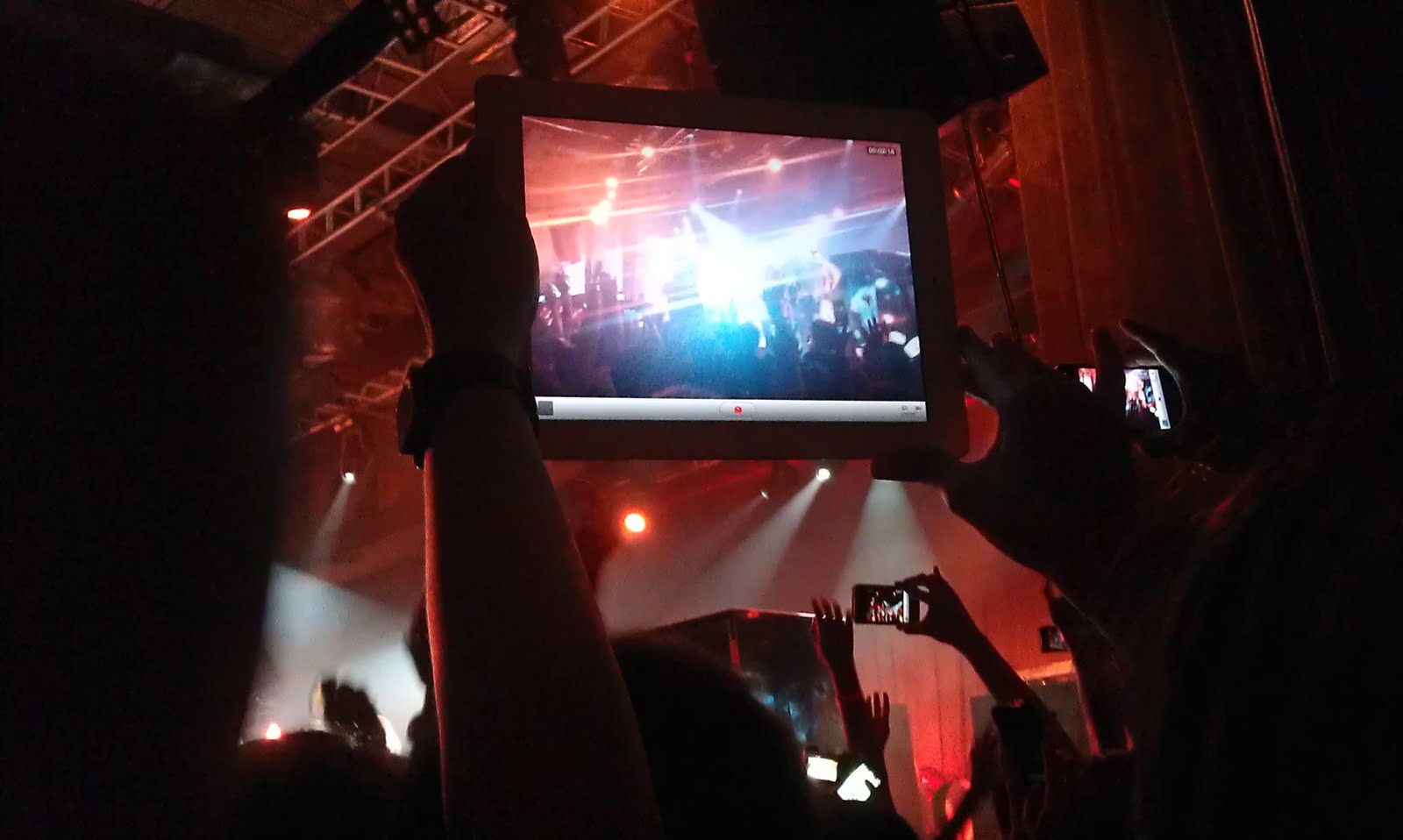
IMAG0218

So where does this leave us?  Well just to recap, using tablets and laptops at live events is potentially:

  • A security risk
  • In breach of copyright law
  • Damaging to the crowd atmosphere
  • Upsetting to the performer

Personally I’d add a fifth item to that list, which is ‘unwatchable’. 

That great concert footage you just have to record invariably ends up being shaky and out of focus, nothing more than a kaleidoscope of unrecognisable bright colours, with sound quality worse than the antiquated PA system at a non-league football ground.

So why is the sight of phones and tablets being held aloft such a familiar picture at every gig, and increasingly at football matches?

To many people, the chance to show off to all your friends just how close you were to the stage at that Beyonce gig, or being the first fan to post your team’s goal on Vine is worth more than the value of the experience itself.

The quality of the footage isn’t the issue.  It doesn’t really matter what it looks like, it’s just proof you were there.

Social currency > Live experience?

I find that concept quite dispiriting.